
Even When You Know Better
✓ You’ve reflected on your past.
✓ You’ve told yourself, “Next time I’ll handle it differently.”
✓ And then it happens again.
SEND ME THE FREE
"WHY YOU REACT" GUIDE
We Hate Spam And Promise To Keep Your Email Address Safe
THE MOMENTS YOU RECOGNIZE
Maybe it’s:
- Snapping at someone you care about.
- Freezing in a conversation.
- Feeling a surge of anxiety before speaking.
- Overreacting to something small.
- Shutting down when criticized.
Later, you replay it in your mind. “Why did I do that?” You knew better.
But in the moment — it wasn’t you thinking. It was something else being activated.
THIS IS NOT A WILLPOWER PROBLEM
You know it!
- If awareness alone solved it, you wouldn’t still be dealing with it.
- If positive thinking worked long-term, you wouldn’t keep circling back to the same patterns.
- You are not weak.
- You are not broken.
- You are not “bad at self-control.”
THE TIMING PROBLEM MOST PEOPLE MISS
Most people assume reactions work like this:
- Your chest tightens.
- Your breathing changes.
- Your tone sharpens.
- Your energy spikes or collapses.
- “Calm down.”
- “Don’t say that.”
- “This isn’t a big deal.”
That isn’t a character flaw.
It’s a matter of sequence.
Want the structured explanation in one place?
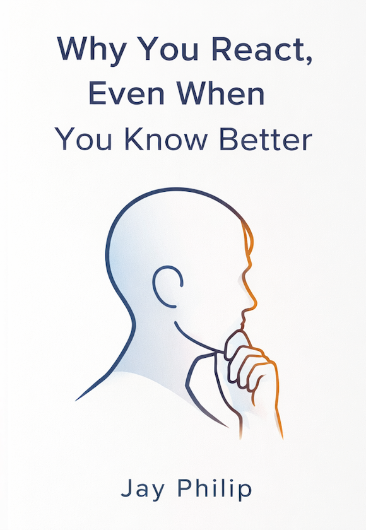
Download the Free "Why You React" Field Guide.
GET THE FREE GUIDE
HOW AUTOMATIC RESPONSES FORM
When something intensely painful happens — emotionally or physically — your system records it.
Not just as a story.
It records:
- Sensations
- Emotional intensity
- Words spoken
- Tone of voice
- The surrounding environment
- Your internal state
It stores them bundled — as a single imprint.
Why?
Because the system’s first priority is survival.
If something hurt once — especially unexpectedly — the system records it so it can react faster next time.
WHY SIMILARITY IS ENOUGH
The present situation does not need to be identical to the past one.
It only needs to resemble it.
- A tone.
- A posture.
- A phrase.
- A feeling in your chest.
When something in the present resembles an earlier painful experience, the stored recording activates.
- It activates fast.
- It activates automatically.
- It activates to prevent you from experiencing that same pain again.
- It does not evaluate whether the present situation is actually dangerous.
- It reacts based on what hurt before.
And when it activates, it overrides analytical thinking.
- The body shifts first.
- The emotion surges next.
- The thought arrives after.
Isn’t that what you observe
WHY INSIGHT ALONE DOESN'T STOP IT
Insight builds awareness.
Breathing techniques can regulate intensity.
Mindset work can reframe interpretation.
All of that can help manage activation.
But managing intensity is not the same as removing activation.
As long as a recording remains emotionally charged, enough similarity under enough pressure will trigger it.
That’s why intelligent, self-aware people still find themselves saying:
“I know why I do this…
I just can’t stop it in the moment.”
The issue isn’t understanding.
It’s activation.
GET THE FREE GUIDE
IS THER A WAY TO ADDRESS THE RECORDING ITSELF?
Yes!
The key isn’t suppressing reactions.
It isn’t fighting them.
It isn’t managing them forever.
It’s identifying and neutralizing the stored emotional charge in the original recording.
When the charge is gone:
- The memory may remain —
- but the automatic activation does not.
- The override doesn’t occur.
That is the difference between coping and resolution.
The Identity Shift
This is the most important part.
You are not your reactions.
The calm, rational, analytical part of you is real.
When activation settles, clarity returns.
That clarity wasn’t created in that moment.
It was simply no longer overridden.
Remove activation — and clarity becomes natural.
You’re not trying to become someone new.
You’re removing what overrides you.
WHERE THIS MODEL COMES FROM
An old book that is still very relevant.
The structured explanation of this mechanism — and the step-by-step method for examining recorded emotional charge — was originally described in a book published in 1950.
It presents:
• The full model of how recordings form
• Why they override reasoning
• How to identify them
• How to reduce their charge in a structured way
If what you’ve read so far matches your experience, the next step is not hype.
It’s deeper clarity.
Read the Free “Why You React” Guide
Inside the guide you’ll find:
• A clear breakdown of the mechanism
• Observable examples you can test in yourself
• A structured explanation of how activation works
• A calm introduction to the original source material
No pressure.
No urgency.
Just clarity.
GET THE FREE GUIDE
This material is educational in nature and is not a substitute for professional medical or psychological care.
If you later choose to explore recommended source material, I may receive a small commission at no additional cost to you.
